
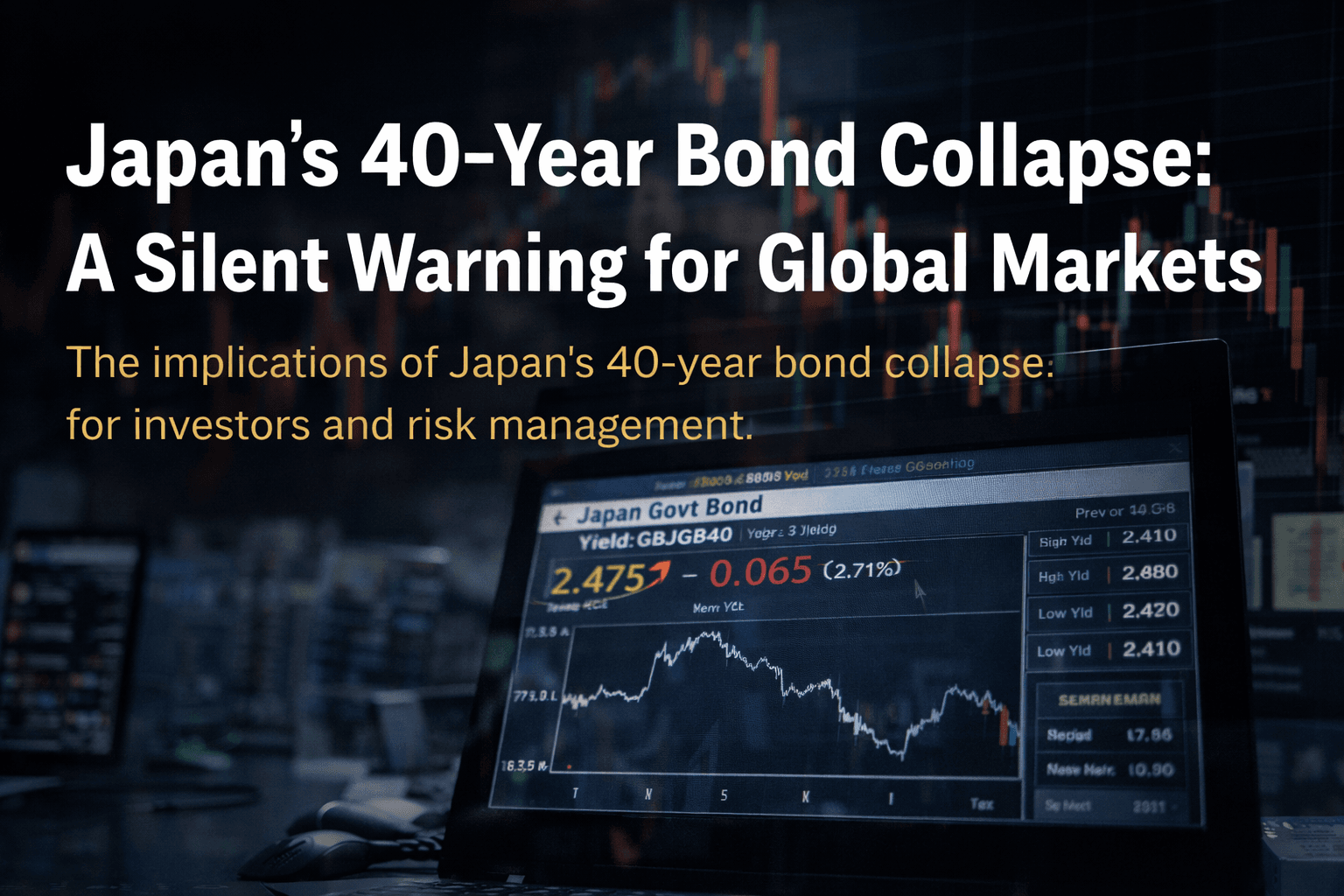
For years, Japan has been seen as an exception in global financial markets. While the rest of the world struggled with inflation, aggressive rate hikes, and bond market volatility, Japan appeared frozen in time: ultra-low interest rates, massive central bank intervention, and a bond market seemingly immune to stress.
That illusion is now cracking.
The recent surge in yields on Japan’s 40-year government bond — a move that may look technical or distant to most retail investors — is anything but trivial. It is a silent warning. One that speaks not only about Japan, but about global debt, duration risk, and the fragility embedded in today’s financial system.
What Is Japan’s 40-Year Government Bond?
Japan issues government bonds (JGBs) across a wide range of maturities, including ultra-long bonds such as the 30-year and 40-year maturities. These instruments are extremely sensitive to changes in interest rates due to their long duration.
In simple terms:
- Longer maturity = higher sensitivity to yield changes
- Small yield increases translate into large price declines
For decades, these bonds were considered “safe” not because of fundamentals, but because the Bank of Japan (BoJ) actively suppressed yields through massive bond purchases and yield curve control (YCC).
The stability was not organic — it was engineered.
Why Are Japan’s Long-Term Bonds Selling Off?
The recent sell-off in Japan’s ultra-long bonds is not driven by panic. It is driven by structural pressure.
1. Yield Curve Control Is Breaking
Japan’s yield curve control policy capped yields artificially. While this worked in a deflationary world, it becomes increasingly unsustainable as:
- Inflation expectations rise
- Global yields move higher
- The yen weakens
The market is slowly testing the limits of BoJ credibility.
2. Duration Risk Is Being Repriced
For years, investors underestimated duration risk because volatility was suppressed. Now:
- Inflation uncertainty is higher
- Central banks are less predictable
- Long-duration assets are no longer “free carry trades”
The repricing is not emotional — it is mathematical.
3. Structural Debt Reality
Japan’s public debt exceeds 250% of GDP. Even small increases in long-term yields dramatically impact debt servicing costs.
Markets understand this. And markets price risk eventually.
Why This Matters Beyond Japan
Many investors dismiss Japan as a “local issue.” That is a mistake.
Japan matters because it sits at the core of the global financial system.
Japan Is One of the World’s Largest Creditors
Japanese institutions hold massive amounts of:
- U.S. Treasuries
- European sovereign bonds
- Global fixed-income assets
When yields rise domestically:
- Capital repatriation becomes more attractive
- Foreign bond selling pressure increases
- Global yields feel the impact
This is not theory. It is balance-sheet reality.
The Silent Risk in Long-Duration Assets

The collapse in ultra-long Japanese bonds highlights a risk most retail investors do not understand: duration risk is not linear.
A 40-year bond does not behave like a 10-year bond.
It behaves like leverage.
- A 1% yield move can mean double-digit price losses
- Recovery is slow
- Volatility compounds over time
This is why long bonds can be more dangerous than equities during regime shifts.
Stocks, Bonds, and the False Sense of Safety
or decades, bonds were seen as the “safe” part of a portfolio. That assumption is now questionable.
When:
- Inflation is unstable
- Debt levels are extreme
- Central banks lose full control
Bonds stop being shock absorbers and start becoming risk transmitters.
Japan’s bond market is a preview, not an anomaly.
What Retail Investors Are Missing
Most retail investors focus on:
- Entries
- Indicators
- Short-term price action
Very few understand macro risk transmission.
The rise in Japan’s 40-year yield is not a trading signal.
It is a risk signal.
It tells us:
- Volatility is migrating from equities to fixed income
- The cost of capital is structurally higher
- Artificial stability has a price
Retail traders often lose money not because they lack intelligence, but because they operate without context.
Is This a Crisis or a Controlled Adjustment?
This is not a crash — yet.
It is a controlled stress test.
But history teaches us something important:
Systems rarely break where everyone is looking.
Japan’s bond market has been quiet for decades. That is precisely why tension accumulates unnoticed.
The danger is not the move itself.
The danger is complacency.
Why This Fits a Broader Pattern
Across global markets we see the same dynamic:
- Rising yields
- Higher volatility
- Less central bank certainty
This environment punishes:
- Overleverage
- Poor risk management
- Short-term thinking
And rewards:
- Discipline
- Capital preservation
- Structural understanding
Markets are not becoming more difficult.
They are becoming more honest.
Final Thoughts: This Is Not About Japan
Japan’s 40-year bond sell-off is not about Japan.
It is about:
- The end of artificially suppressed risk
- The repricing of long-duration assets
- The transition to a higher-volatility regime
Investors who understand this will adapt.
Those who ignore it will keep searching for answers in indicators, while the real risk moves beneath their feet.
In markets, survival always comes before return.
And right now, the bond market is quietly reminding us of that rule.