

Retail trading has exploded over the last two decades. Millions of individuals now have access to markets once dominated by institutions. Yet a harsh reality remains: most retail traders lose money consistently.
This is not simply because markets are unpredictable. In practice, retail losses are often driven by a predictable mix of factors: confusing analysis with execution, falling for “easy money” marketing, being trapped by cognitive biases such as overconfidence, and operating without rigorous risk management. This guide breaks down the core reasons behind those losses—and what professionals do differently.
- Analysis ≠ execution: a clean chart is not the same as trading real money.
- Hype and FOMO pull retail traders into exhausted moves.
- Overconfidence and revenge trading destroy accounts.
- Without risk management, survival is impossible.
- Professionals win through process, discipline, and probability thinking.
Analysis Is Not Execution
A costly misunderstanding in retail trading is the belief that being a good technical or fundamental analyst automatically makes you a good trader. They are different skills.
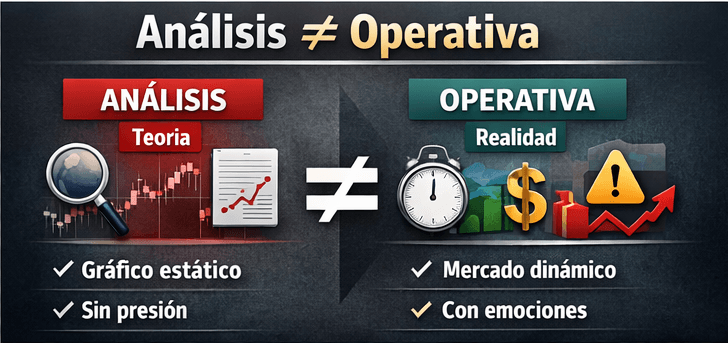
Analysis is often done in a controlled, “cold” environment—identifying trends, support, resistance, and key zones. Execution happens in real time, where volatility spikes, opening gaps, and sudden reversals introduce pressure and uncertainty.
A trade can be “perfect” on paper, yet fail in live conditions because real markets don’t behave like static screenshots. Trading is not just analysis—it’s risk control, position sizing, and emotional discipline.
The Easy Money Illusion
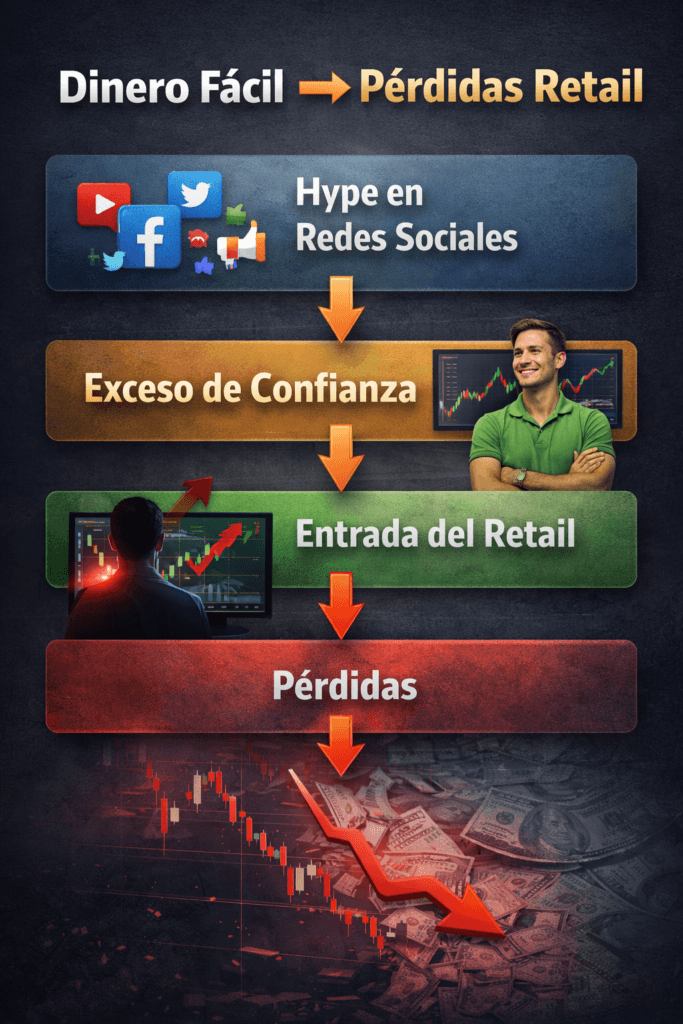
The online trading industry sells a powerful story: making money is fast, simple, and accessible from home. Ads, “miracle” courses, funded-account offers, and broker affiliate campaigns often create unrealistic expectations.
Social media amplifies the problem. Many influencers showcase winning streaks while hiding drawdowns and the true risk taken. They also create attention waves around specific assets—prices move not because of fundamentals, but because “everyone is talking about it.” Retail traders enter late, driven by FOMO, becoming exit liquidity for more prepared participants.
Overconfidence and Short-Term Thinking
After a few winning trades, overconfidence appears. Position sizes increase, rules loosen, and traders start believing they “figured it out.”
Then losses arrive—and many fall into revenge trading: trading more, risking more, not to execute a plan but to recover losses quickly.
Underneath it all is short-term thinking: the obsession with the “big win.” But trading is a long-term game. A professional mindset asks:
“Will I still be trading 15 years from now?”
No Risk Management, No Survival
Markets don’t reward the smartest trader—they punish the one who manages risk poorly. Even a strong strategy becomes useless if a single losing trade can wipe out the account.
Returns mean nothing without risk
High returns are meaningless without knowing the risk taken to achieve them. The key metric is drawdown. Making 20% with controlled risk is skill. Making the same 20% while risking half your capital is usually an accident waiting to happen.
Position sizing mistakes
Professionals size positions so that hitting the stop loss costs a small, predefined percentage (typically 1–2%). Common mistakes include excessive leverage and inconsistent risk (“this one is a sure thing, so I’ll risk more”).
Capital preservation first
Losses are asymmetric: a 50% drawdown requires a 100% gain to break even. That’s why the core rule is:
“Protect the capital.”
Sometimes, not trading is the best trade.
Emotions: The Silent Enemy
Fear and greed distort reality.
- Greed shows up as FOMO, pushing late entries and oversized risk.
- Fear causes early exits, missed setups, and hesitation.
The crowd buys in euphoria (tops) and sells in panic (bottoms). Emotional trading turns you into liquidity for systematic traders.
What Professionals Do Differently
Professionals don’t try to predict the market. They focus on:
- Process over predictions: executing rules, not being “right.”
- Discipline as protection: rules exist to protect you from yourself.
- Probability thinking: one trade means nothing; the series matters.
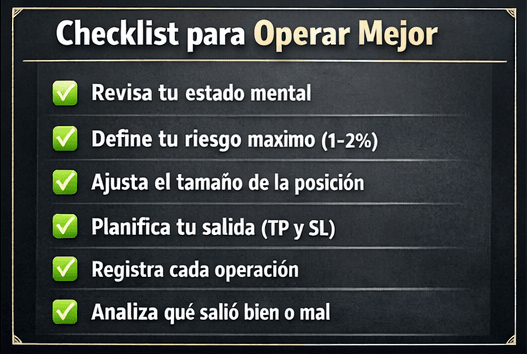
A Practical Framework (Checklist)
- Mental state: if you’re not neutral, don’t trade.
- Max risk: 1–2% per trade.
- Clear setup: if it’s not obvious, skip it.
- Correct position size: based on stop distance and monetary risk.
- Exit plan first: stop loss and take profit defined before entry.
- Journal the trade: review patterns and mistakes.
When to trade
- Clear trend, reasonable volatility
- You’re rested and focused
- A validated setup (not improvisation)
When not to trade
- Emotional state (tilt)
- Choppy markets without direction
- Assets you don’t understand
- High personal stress
Conclusion
Retail traders don’t lose because they lack intelligence. They lose because they lack structure: confusing analysis with execution, falling for hype, trading under bias, and underestimating risk and emotions.
Consistency beats brilliance. The goal is survival, learning, and repeatable execution. Over time, that’s what separates the trader who quits from the trader who builds results.